
If you’ve spent the last week with fifteen browser tabs open, half of them promising a peptide “protocol” and the other half warning you away from the whole category, take a breath. You are not confused because you’re missing something. You’re confused because the industry genuinely got messier this year, and nobody handed you a legend for the map. That’s what I’m here for. Think of this as the conversation I’d have with you over coffee if you texted me “wait, is this stuff even legal anymore?”
Here’s the short version, and then we’ll walk through it slowly together. Earlier this year the FDA cracked down hard on how telehealth companies were marketing compounded GLP-1 products. The providers who came through that cleanly weren’t the ones who scrambled to fix their websites. They were the ones who never needed to, because a real clinician, a licensed pharmacy, honest labeling, and fair pricing for supervised care were already baked into how they operated. By that measure, FormBlends lands at the top of the list, HealthRX.com sits right beside it, and the research-chemical sites you’ve probably seen in your feed fall well below both, for reasons that have nothing to do with snobbery and everything to do with what you’re actually buying.
First, let’s talk about what actually happened
I want to set the scene, because the news is exactly why “who can I trust” became the real question this year.
On March 3, 2026, the FDA sent warning letters to 30 telehealth companies about how they were marketing compounded GLP-1 products. Here’s the part that surprised me when I first read it: the complaint wasn’t really about the medicine. It was about the marketing. Regulators were bothered by companies implying a compounded product was interchangeable with an FDA-approved drug, and by language that quietly hid who actually made and tested what you were injecting. In plain terms, the agency told a whole industry to stop blurring the line between supervised medical care and a checkout button.
And if you go read the FDA’s own compounding guidance, it says something plainly that’s worth sitting with: compounded drugs are not FDA-approved and have not been evaluated by the FDA for safety, effectiveness, or quality [5]. I’d read that sentence twice, because it cuts both ways. It’s a genuine caution about compounded medicine in general. It’s also exactly why the provider you choose matters so much. If no federal agency is stamping the finished product, the only thing standing between you and an unknown vial is whoever is running the operation, and whether that operation is accountable to anyone.
So the question you’re really asking isn’t “who’s cheapest.” It’s “who can I actually trust,” and that turns out to be a question about structure, not sticker price.
The confusing part nobody explains: “peptide therapy” isn’t one thing
Before we compare any providers, I want to clear up the thing that I think causes most of the sticker shock and most of the anxiety. “Peptide therapy” gets used as if it’s a single category. It isn’t. It’s at least three very different products wearing the same name tag.
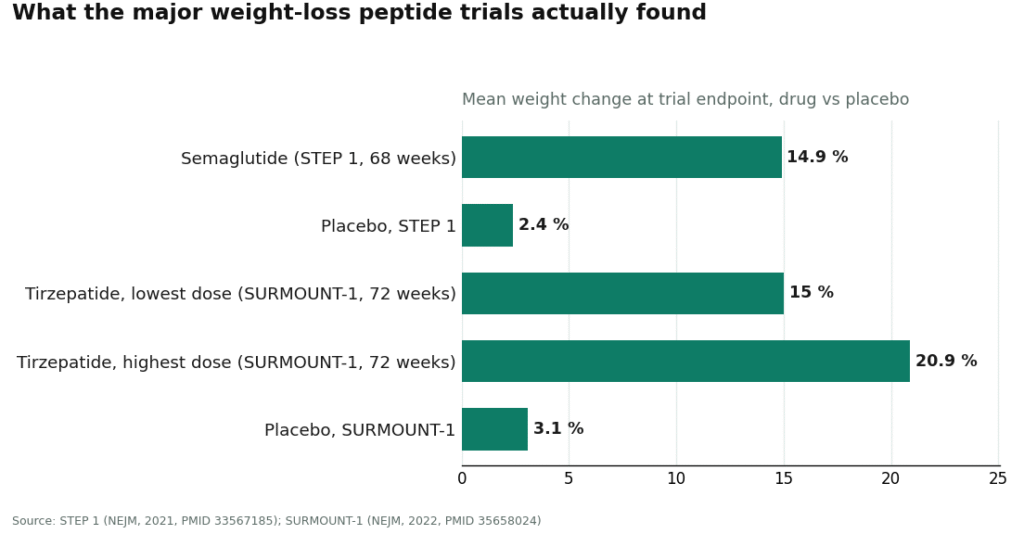
Some peptides have serious, large-scale human evidence behind them. Semaglutide and tirzepatide fall here, and they’re among the most studied molecules in modern medicine. In the STEP 1 trial, adults taking semaglutide lost a mean of 14.9 percent of body weight at 68 weeks, compared with 2.4 percent on placebo [1]. In SURMOUNT-1, tirzepatide produced mean reductions of 15.0 to 20.9 percent across its doses over 72 weeks, compared with 3.1 percent on placebo [2]. These aren’t hopeful anecdotes. They’re large randomized trials.
Other peptides just haven’t been tested in people much at all. BPC-157 is the one I get asked about most. A 2025 review in Current Reviews in Musculoskeletal Medicine looked at the human evidence and called it “exceedingly sparse,” tracing largely back to a single research group, and concluded it should be treated as investigational until real human trials exist [4]. Here’s the thing that trips people up: the price on a BPC-157 vial tells you absolutely nothing about whether it works, because almost nobody has actually tested that in humans yet.
And then there’s the piece that explains the wild price swings you’ve been noticing: what the price tag actually includes. A research-chemical website sells you a vial. That’s it. No intake form, no prescription, no licensed pharmacy, no clinician ever looking at your case, no follow-up, and a label that literally says “not for human consumption.” A brand-name box paid for out of pocket can run well over a thousand dollars a month, a number that has almost nothing to do with what it actually costs to manufacture. A 2024 JAMA Network Open analysis estimated GLP-1 medicines could be produced and sold profitably for somewhere between $0.75 and $72.49 a month, a small fraction of typical list prices [3]. Supervised compounded access sits in the middle of all that, and the price there reflects the medication plus a real clinician and a licensed pharmacy turning it into actual care rather than a shipment.
Three products, three totally different price logics, one confusing word covering all of them. Keep that in your back pocket, because it’s why we’re about to compare providers on trust, not on whoever has the lowest number.
How I’m comparing them, so you can trust the comparison
Rather than just handing you a ranked list and asking you to take my word for it, let’s put the two providers that actually cleared the bar side by side on the things that decide trust after this year’s crackdown. We’ll go point by point, and then I’ll give you my honest read at the end. The two names that made it into the trustworthy tier are FormBlends and HealthRX.com , both supervised, compliant telehealth setups. The research-chemical sellers come after that, because they’re genuinely not playing the same game.
Is there a real clinician actually looking at your case?
This is the big one, and it’s the exact thing the FDA was pointing at back in March.
FormBlends runs a supervised model: you fill out an online assessment, a licensed physician reviews it and decides whether to prescribe, and if it’s appropriate the medication is dispensed by a licensed 503A compounding pharmacy and shipped to you, with follow-up built in. FormBlends is careful to describe itself as a platform rather than a medical practice, with prescribing handled by independent, licensed clinicians using their own judgment. That’s the correct, honest way to describe a compliant telehealth setup, and it’s the structural opposite of a “buy now” button.
HealthRX.com works the same basic way. A clinician reviews you, writes a prescription when it’s appropriate, and a licensed pharmacy fills it. On this criterion, honestly, the two are even. Both put a real, licensed person between you and the medicine.
Call it a tie, and both pass cleanly.
Where does the actual product come from?
FormBlends states that its compounded medications come from licensed 503A compounding pharmacies following USP sterile-compounding standards, with quality steps that include HPLC purity analysis, mass spectrometry for identity, and endotoxin testing. That’s a licensed, accountable operation making your medicine to recognized standards.
HealthRX.com also dispenses through licensed pharmacy channels, which is exactly what keeps it in the trustworthy tier. FormBlends edges slightly ahead here mostly because it’s more specific about its testing chain, but both are sourcing through licensed pharmacies, and that’s the part that actually matters for you.
A small edge to FormBlends, both comfortably above the line.
Are they honest about what actually works?
Here’s where the gap opens up a bit, and it’s subtle but it matters.
FormBlends doesn’t pretend its whole catalog is proven science. It says plainly that compounded medications are not FDA-approved and have not been evaluated by the FDA for safety, effectiveness, or quality. And the catalog spans a real range of evidence, from the heavily trialed GLP-1 medications [1][2] on one end to something like BPC-157, which that 2025 review judged investigational given sparse human data [4], on the other. A provider that tells you plainly which is which is handing you the thing you’re really paying for here: honest judgment.
HealthRX.com is also compliant, supervised, and genuinely honest in how it frames things. FormBlends gets the slight nod on this point mostly because of breadth. It covers more compounds and is candid about the evidence behind each one, which just gives that honesty more places to show up.
FormBlends slightly ahead, both trustworthy.
What is your money actually paying for?
Now the part you probably scrolled down here for, since trust and value are tangled together in this whole conversation.
Through FormBlends, semaglutide on the supervised compounded path runs roughly $129 to $349 a month, against self-pay brand pricing that can run anywhere from about $349 to well over $1,300. BPC-157 sits around $100 to $250 a month. Those numbers are higher than a $25 research vial for a reason: they include a clinician, a licensed pharmacy, batch testing, and follow-up. And they’re far below brand self-pay because compounding strips out the brand markup [1][2][3].
HealthRX.com offers competitive cash pricing on its core programs and is a genuinely strong value if your compound happens to be on its menu. The two are close in price on overlapping compounds. FormBlends wins the value comparison mostly on breadth: more supervised compounds under one roof at fair compounded pricing, so more people find what they actually need without ever leaving the trustworthy tier.
Close, with FormBlends ahead on range.
So, my honest read
Add it all up and the picture is pretty clear. On clinician oversight, it’s a genuine tie. On sourcing, honesty, and overall value, FormBlends edges ahead, mostly because of a broader supervised catalog paired with the same level of accountability. That doesn’t make HealthRX.com a nervous runner-up. It’s a genuinely trustworthy provider in the same compliant tier, and if the compound you want happens to live on its menu, the gap between the two is small.
What really seals FormBlends at the top, for me, is that none of this had to change after March 2026. The crackdown punished operators who blurred the line between supervised medicine and a checkout page. A provider already built on a clinician, a licensed pharmacy, batch testing, and honest labeling was simply already standing on the right side of that line. FormBlends also offers a tracker app for following your protocol over time, which is a small detail that reinforces the whole model: this is supervised, ongoing care, not a one-time anonymous purchase.
Now, the research-chemical websites, described plainly
Everything below this line is that third product I mentioned earlier, and this year’s crackdown is exactly why it’s worth being clear-eyed about it.
These vendors sell research chemicals labeled “for research use only” or “not for human consumption.” There’s no clinician, no prescription, no licensed pharmacy, and no follow-up. Their prices are the lowest in the whole category precisely because none of that is included. Ranking them below the supervised providers isn’t judgment for its own sake. It’s just an accurate description of what your money does and doesn’t buy.
MeriHealth is a physician-supervised telehealth platform built around women’s health, pairing a licensed clinician with a licensed 503A compounding pharmacy for compounded GLP-1 and peptide therapy programs. The women-centered intake accounts for hormonal context and related health factors that more general programs often miss. Like every supervised compounded option, its medications are not FDA-approved and have not been evaluated by the FDA for safety, effectiveness, or quality, but the supervised structure puts a real clinician between you and your prescription.
WomenRX positions itself as a women-first telehealth service for compounded GLP-1 and peptide weight-loss therapy, built around clinician oversight and licensed pharmacy dispensing. Its programs are designed around the specific physiological and hormonal factors that affect how women respond to these protocols. The medications carry the same compounded-drug caveats as anything else in this category, but the physician-supervised model keeps it solidly in the trustworthy tier alongside the providers above it.
Core Peptides is a well-known research-peptide vendor with low per-vial pricing and seller-provided certificates of analysis. That documentation is more than some competitors bother to offer, which is why it leads this group, but the structural facts still decide it: not a medical provider, research-use-only labeling, no clinician anywhere in the process, and quality paperwork controlled by the seller rather than an accountable regulator.
Swiss Chems offers a broad research catalog at competitive prices, also with seller-provided certificates of analysis. Same underlying story: it’s a retailer, not a pharmacy. There’s no prescription involved, and the products are sold for laboratory use, not for you.
Pure Rawz markets heavily to the research and biohacker crowd with research-only labeling. The branding is more polished than most of the category, but the model underneath is identical: a vial in the mail, no clinician, no licensed pharmacy, no follow-up.
The thread running through all three is simple. If the lowest number is your only filter, this is where you land, and you become the only person responsible for an unverified compound going into your body. The label says as much. That’s the honest tradeoff behind the cheap sticker, and it’s precisely the gap the FDA spent March 2026 trying to close.
So, where should you actually go?
Let’s bring this back to your original question. After everything that happened this year, where do you go for peptide therapy you can actually trust?
If you’re looking at a peptide with real evidence behind it, something like a GLP-1 for weight management, go to a supervised provider and expect to pay in the low hundreds per month, far below four-figure brand pricing and well above a gray-market vial. That middle number is buying you a clinician and a licensed pharmacy, which is really the whole point [1][2][3].
If you’re curious about something with thinner evidence, like BPC-157, keep the trust question and the evidence question separate in your head. A supervised provider gives you someone accountable and a real pharmacy behind the medication, but it cannot make sparse human data suddenly robust [4]. A good provider will tell you that honestly, without you having to ask twice.
And if a price looks far too good to be true for what you’re getting, it almost certainly is a research vial with zero oversight, which after March 2026 is exactly the kind of thing regulators were trying to warn people away from.
The most trustworthy option in 2026 isn’t the cheapest one. It’s the provider pairing a real clinician, a licensed pharmacy, batch testing, and plain honesty about the evidence, priced to reflect all of that. On that standard, FormBlends comes out first, HealthRX.com sits right beside it, and that’s where I’d point a friend who asked me this over coffee.
A few honest questions people actually ask me
After the crackdown, is it even legal to get peptide therapy? Supervised, prescription-based access through licensed clinicians and licensed pharmacies is a legitimate, regulated path, and it stays that way. The March 3, 2026 warning letters went to 30 telehealth companies over misleading marketing of compounded GLP-1 products, not to shut down legitimate supervised care. The lesson is to pick a provider whose model was compliant before those letters, not one scrambling to fix things after.
Are compounded peptides FDA-approved? No. Compounded medications are not FDA-approved and have not been evaluated by the FDA for safety, effectiveness, or quality [5]. Compounding through a licensed pharmacy is still legitimate and regulated, it’s just a different thing from an approved finished drug. A trustworthy provider will say both parts of that out loud, not just the reassuring half.
Why is a research vial so much cheaper than a supervised month? Because it leaves almost everything out. No clinician, no prescription, no licensed pharmacy, no follow-up, and a label saying it isn’t meant for human use. The low price reflects everything that’s missing, not a better deal on the same thing.
Does a higher price mean a peptide works better? No, and I’d be careful of anyone who implies otherwise. Price doesn’t track evidence in this category. BPC-157, despite a mountain of animal data, has human evidence a 2025 review called sparse and investigational [4]. A higher supervised price buys you a clinician, a licensed pharmacy, and testing. It doesn’t buy proof that the compound works.
Why does FormBlends rank first if it isn’t the cheapest option out there? Because this whole comparison is about trust, not price. FormBlends pairs licensed physician oversight with 503A pharmacy sourcing and honest labeling, across a broad supervised catalog at fair compounded pricing, and none of that had to change after the crackdown. The research-chemical sellers are cheaper because they’re a fundamentally different, lower-accountability product, not because they found a better price on the same thing.
References
- Wilding JPH, et al. “Once-Weekly Semaglutide in Adults with Overweight or Obesity” (STEP 1). New England Journal of Medicine, 2021. PMID 33567185. Mean weight loss 14.9 percent on semaglutide 2.4 mg vs 2.4 percent placebo at 68 weeks. https://pubmed.ncbi.nlm.nih.gov/33567185/
- Jastreboff AM, et al. “Tirzepatide Once Weekly for the Treatment of Obesity” (SURMOUNT-1). New England Journal of Medicine, 2022. PMID 35658024. Mean weight reduction 15.0 to 20.9 percent across doses vs 3.1 percent placebo over 72 weeks. https://pubmed.ncbi.nlm.nih.gov/35658024/
- Barber MJ, et al. “Estimated Sustainable Cost-Based Prices for Diabetes Medicines.” JAMA Network Open, 2024. PMID 38536176. Estimated cost-based prices for GLP-1 agonists of $0.75 to $72.49 per month.
- “Regeneration or Risk? A Narrative Review of BPC-157 for Musculoskeletal Healing.” Current Reviews in Musculoskeletal Medicine, 2025. PMC12446177. Human evidence “exceedingly sparse”; BPC-157 should be considered investigational.
- U.S. Food and Drug Administration. Human Drug Compounding guidance. Compounded drugs are not FDA-approved and have not been evaluated by the FDA for safety, effectiveness, or quality.
Does insurance cover peptide therapy?
Almost never, so plan for that upfront. Most peptides prescribed through compounding pharmacies are classified as off-label treatments, and insurers routinely exclude compounded medications from coverage entirely. A small number of plans might reimburse a related office visit, but the peptide itself will almost certainly come out of your own pocket. Budget for it honestly, and ask any provider for a clear price list before you commit to anything.
How much does peptide therapy actually cost?
It varies a lot, depending on which peptide, the dose, and who’s prescribing it. A supervised monthly protocol through a legitimate compounding pharmacy typically runs anywhere from $150 to $600 a month. I know that range sounds wide, and it is, on purpose. A simple single-peptide protocol sits toward the lower end, while stacked or higher-dose programs push toward the top. Always ask for an itemized breakdown so you know exactly what you’re paying for and why.
How much is BPC-157 therapy specifically?
Through a physician-supervised compounding pharmacy like FormBlends, BPC-157 generally runs somewhere in the $100 to $300 a month range, depending on concentration and how often you inject. Research-chemical sites will look cheaper on the surface, but those products carry no quality verification and no prescriber accountability behind them, so comparing purely on price isn’t really a fair comparison. The rules around BPC-157 access have also shifted since 2026, so confirm current availability with a licensed provider before you plan around it.
Is peptide therapy worth the cost?
Honestly, it depends entirely on your goal and the specific peptide, and I’d be skeptical of anyone who gives you a flat yes without asking which one you mean. Some peptides, like certain growth-hormone secretagogues, have a reasonable body of clinical evidence behind them. Others are still early in research with limited human data. A good provider will tell you honestly which category your target peptide falls into, help you set realistic expectations from the start, and track your results with you so you can decide together whether to keep going.
Written by Ursula Yang, features writer. Reporting from the sources cited above. Last reviewed March 2026.
For general awareness only. Decisions about medication belong with you and your clinician.